The perfect size for your dining table
Perhaps your eye is drawn to a round table, while a rectangular table might work best in your space. Rectangular tables fit well in narrower, longer rooms, while a round table is more dynamic in a small room. The size of the table and the available space for chairs also play a role. In short, plenty to think about.
What table size should you choose? Measuring is knowing
Not sure about the right table size? Use tape to mark the dimensions of the table on the floor. This gives you a clear idea of how the table will look in the space and whether there is enough room to move around.
Besides the space the table takes up, dining chairs also need enough room to slide in and out comfortably. If you don’t need to walk behind the table on one side, we recommend leaving 70 cm of space. This gives you enough room to sit down and stand up easily. If the table is in a walkway where you do need to pass through, then a minimum of 110 cm is recommended. This allows chairs to be moved comfortably while still leaving room to walk. No space for that? Then a dining bench might be a solution. You can place it against the wall, which creates a playful look and saves space.
Length x width x spacing
The standard width of a dining table is around 90–100 cm, and for many models 80 cm is also possible. A narrower table can create more walking space around it, but in longer sizes it may make the table look small or unbalanced. For tables over 200 cm, we recommend a minimum width of 90 cm.
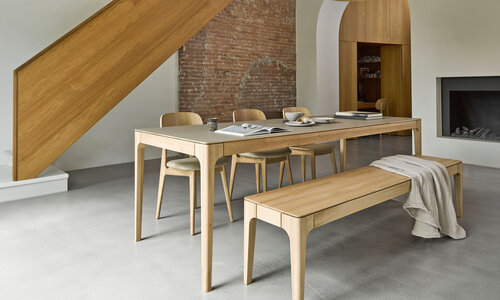
The length of the table is just as important. There needs to be enough room for the desired number of chairs, and the table legs also take up space. On some tables the legs require more room than on others. For example, the legs of the Rikke table are placed on the outer corners, taking up 5 cm per leg. The Samt table has legs positioned much further inwards—28 cm per leg. The placement of the legs can therefore determine whether one extra chair will fit or not.
To easily estimate the right table size, we recommend counting 60 cm per chair. A chair is usually narrower, but the extra space makes sitting down and getting up more comfortable. If you want to seat 6 people, 3 on each side, the table should be at least 180 cm long—this calculation does not yet include the space taken up by the legs. With a Rikke table, this would mean choosing a 190 cm table, while with the Samt you would end up at 240 cm.
Which table works in a small dining area?
A small space but often guests over for dinner? Consider an extendable table. Several tables in the Sav & Økse collection are available as extendable models. For example, the Gunni, Rikke, and Fjerre extend from the side, keeping one end of the tabletop in place. This is ideal if you want to place the table against a wall. There are also the rectangular and round extendable Nonne tables, which extend from the center so the table legs remain in place. The extension creates a longer tabletop.

Photos: Nonne extendable table, oak whitewash
A round table for small spaces
Prefer a round table? There are plenty of options. Round tables work very well in small spaces because you can easily walk around them. A round table like the Volante is a real eye-catcher in the dining room. The central leg also makes it easy to seat an extra person when needed. Most round tables come in a diameter of 120, 130, or 140 cm. Tip: tape the measurements on the floor to find the ideal size.
Choose the perfect table for your dining area
The Sav & Økse table collection includes rectangular, round, and oval tables in various models and sizes. With this wide range, there is a suitable table for every interior. If you’d like to see the tables in person, you’re very welcome in one of our showrooms.
This article was previously published on demachinekamer.nl.